Can Sleep Therapy Fit Into Cardiac Rehab? A Review Weighs In
By ELESSAR
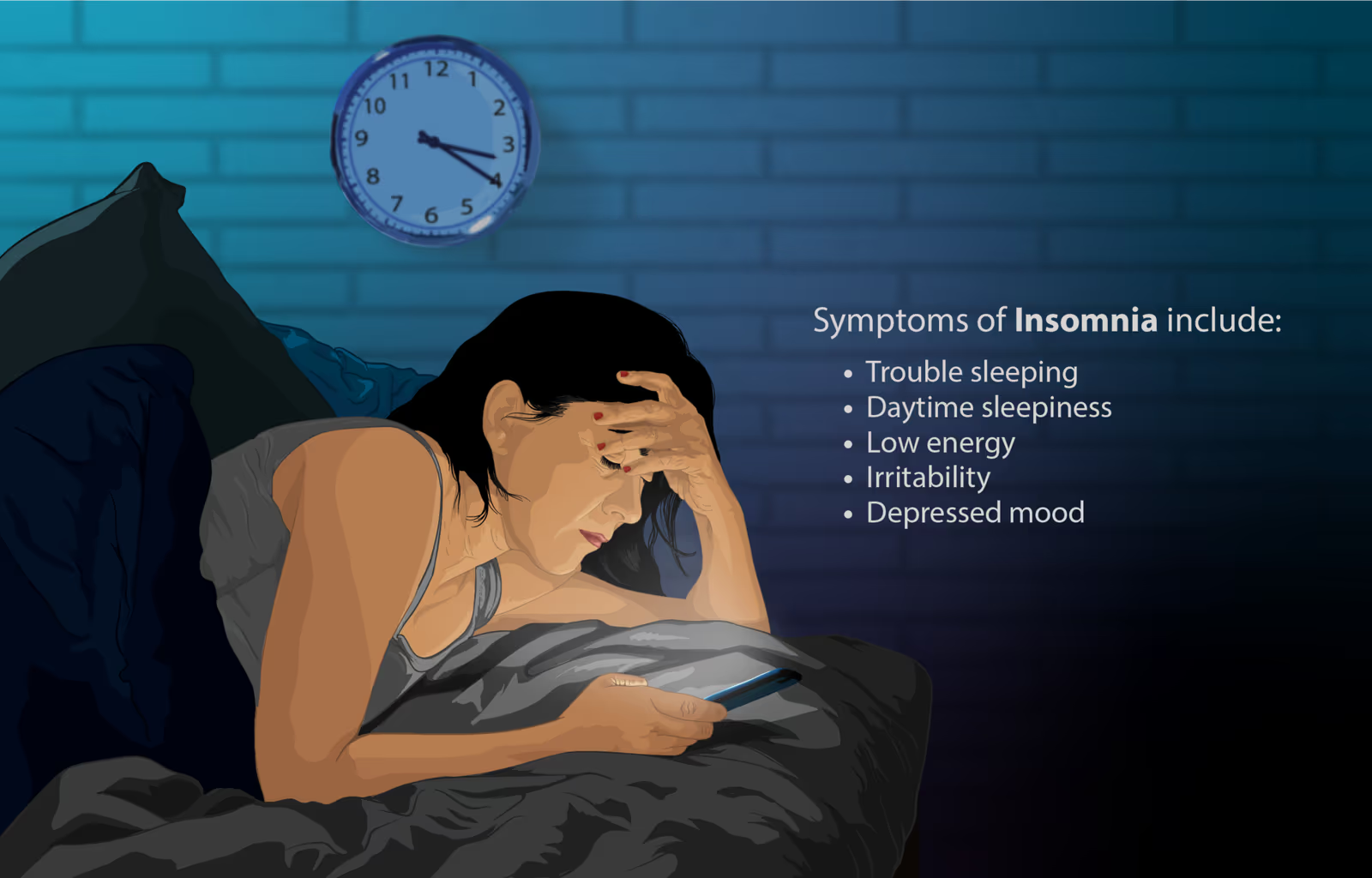

Can Sleep Therapy Fit Into Cardiac Rehab? A Review Weighs In
People recovering from heart trouble are told to exercise, eat well and take their medication. What they are rarely asked about is how they sleep, even though broken sleep is common after a cardiac event and tied to worse outcomes.
Sleep sits awkwardly in heart care. Poor sleep, and insomnia in particular, is unusually frequent among people with cardiovascular disease, and studies have linked it to higher rates of death in this group. Yet it is rarely treated as something a cardiac team should tackle directly. Guidelines for heart care and the structured recovery programmes known as cardiac rehabilitation, where patients exercise, learn about their condition and adjust their habits after an event such as a heart attack, give sleep problems little formal attention. A new review set out to ask whether that gap could be closed using behaviour change methods, meaning structured techniques that help people alter habits and thoughts rather than relying on medication.
The work is a scoping review, a type of study that maps what research already exists on a question rather than running a fresh experiment or pooling numbers into a single verdict. Two researchers, White and Atef, searched four medical databases using a standard framework that specifies the patients, the intervention, the comparison and the outcome of interest. Their search returned 782 records. After screening, 23 studies made it into the review, one of them found by following up references in another paper. The studies were a mixed bag by design: randomised controlled trials, in which patients are assigned by chance to one approach or another; smaller pilot trials; re-analyses of existing data; and systematic reviews that had themselves gathered earlier work.
One approach came up more consistently than any other. Cognitive behavioural therapy for insomnia, a talking treatment that reshapes the habits and anxious thoughts that keep people awake, emerged as the most reliably effective option across the studies the authors examined. It appeared to work not only in the traditional one-to-one setting but also when delivered to groups or through websites, formats that matter because they are cheaper to run and easier to slot into a busy rehabilitation clinic. A shorter, more streamlined variant, described in the review as brief behavioural treatment for insomnia, also drew attention. It is designed to be flexible and quick to adapt, and the studies reviewed reported encouraging reductions in how severe people's insomnia was.
That is the shape of the finding: among heart patients, structured behavioural treatments for sleep seem to improve measured sleep outcomes and to ease insomnia, and some of them can be delivered in ways that would plausibly fit inside existing rehabilitation programmes. It is a hopeful signal, and it points in a clear direction. What it does not do is settle the matter, and the review is honest about why.
A scoping review can tell you what has been tried and roughly how it went. It cannot tell you, with the precision of a large pooled analysis, how big the benefit is or how durable. The authors flag two problems in particular. The studies differed a great deal from one another in how the interventions were built and delivered, so what worked in one trial was not always the same thing tested in the next. The patient groups also varied, which makes it harder to know who benefits most. When protocols and populations are this heterogeneous, a promising pattern is easier to see than a firm dose of advice is to write.
There is also the question of whether any of this survives contact with a real clinic. Cardiac rehabilitation is already a full programme, with limited time and staff, and adding a sleep component means finding room for it. The review argues that future studies need to bring in the people who would actually run these programmes, clinicians and patients alike, to shape interventions that can be delivered rather than merely tested. It points to telehealth, meaning care delivered remotely by phone or online, as a route worth exploring, precisely because it could add sleep support without demanding more in-person hours.
What is genuinely new here is less any single treatment than the framing. Cognitive behavioural therapy for insomnia is well established in the general population; it is widely regarded as a first-line option for chronic insomnia. The contribution of this review is to gather the evidence specifically for people with cardiovascular disease and to ask whether it belongs inside cardiac rehabilitation, a setting where sleep has been treated as someone else's problem. The answer the authors reach is that the potential is real and the case for trying is reasonable, while the practical blueprint is still missing.
For a heart patient reading this, the honest takeaway is modest but not empty. Persistent insomnia is not something to accept as an inevitable part of recovery, and effective non-drug treatments for it exist. Whether a given rehabilitation programme offers them is another matter, and one worth raising with the clinical team rather than assuming. The review does not claim that treating insomnia will lengthen anyone's life or prevent a second cardiac event; the link between poor sleep and worse outcomes is an association drawn from observation, not proof that fixing the sleep fixes the risk. What it does suggest is that sleep deserves a seat at the table in heart recovery, and that the tools to address it are already on the shelf, waiting for the research that would show how best to use them.
Sources
- Could behaviour change interventions be incorporated into cardiac rehabilitation programmes for insomnia and poor sleep quality management? A scoping review.White E, Atef H · 2026 · Sleep & breathing = Schlaf & AtmungDOI 10.1007/s11325-026-03707-xPMID 42176203