How Chronic Inflammation May Erode Mobility as We Age
By ELESSAR

How Chronic Inflammation May Erode Mobility as We Age
Growing older often comes with a quieter kind of change than a bad knee or a sudden fall: a slow, simmering inflammation inside the body that never quite switches off. Scientists have a name for it, and they think it helps explain why so many people lose their footing with age.
The word is inflammaging, a blend of inflammation and aging, and it describes the chronic, low-grade activation of the immune system that tends to build up over the decades. Unlike the sharp, useful inflammation that fights off an infection and then fades, this version lingers in the background at a low hum. A recent review published in Aging Clinical and Experimental Research gathers the evidence on how that persistent inflammation may be tied to one of the most consequential losses of later life: the ability to move well.
Mobility is easy to take for granted until it starts to slip. Rising from a chair, walking to the shops, keeping steady on uneven ground: these depend on muscle, joints, bone and the nervous system all working together. The review, written by Patusco, Gyasi and Kaufmann, argues that chronic inflammation quietly undermines each of these systems. The authors connect inflammaging to muscle wasting known as sarcopenia, to the joint disease osteoarthritis, and to the unsteady, hesitant gait that raises the risk of falls. Taken together, these changes chip away at what the authors call the mobility span, the years a person can move freely and independently.
This is a review, meaning the authors did not run a new experiment or follow a group of people over time. Instead they synthesised findings from existing research, drawing on studies in both humans and animals to build a picture of how the biology fits together. That approach is valuable for mapping a field and pointing out where the strongest ideas lie, but it cannot by itself prove that inflammation causes mobility decline. It describes a web of associations and plausible mechanisms rather than a single decisive trial.
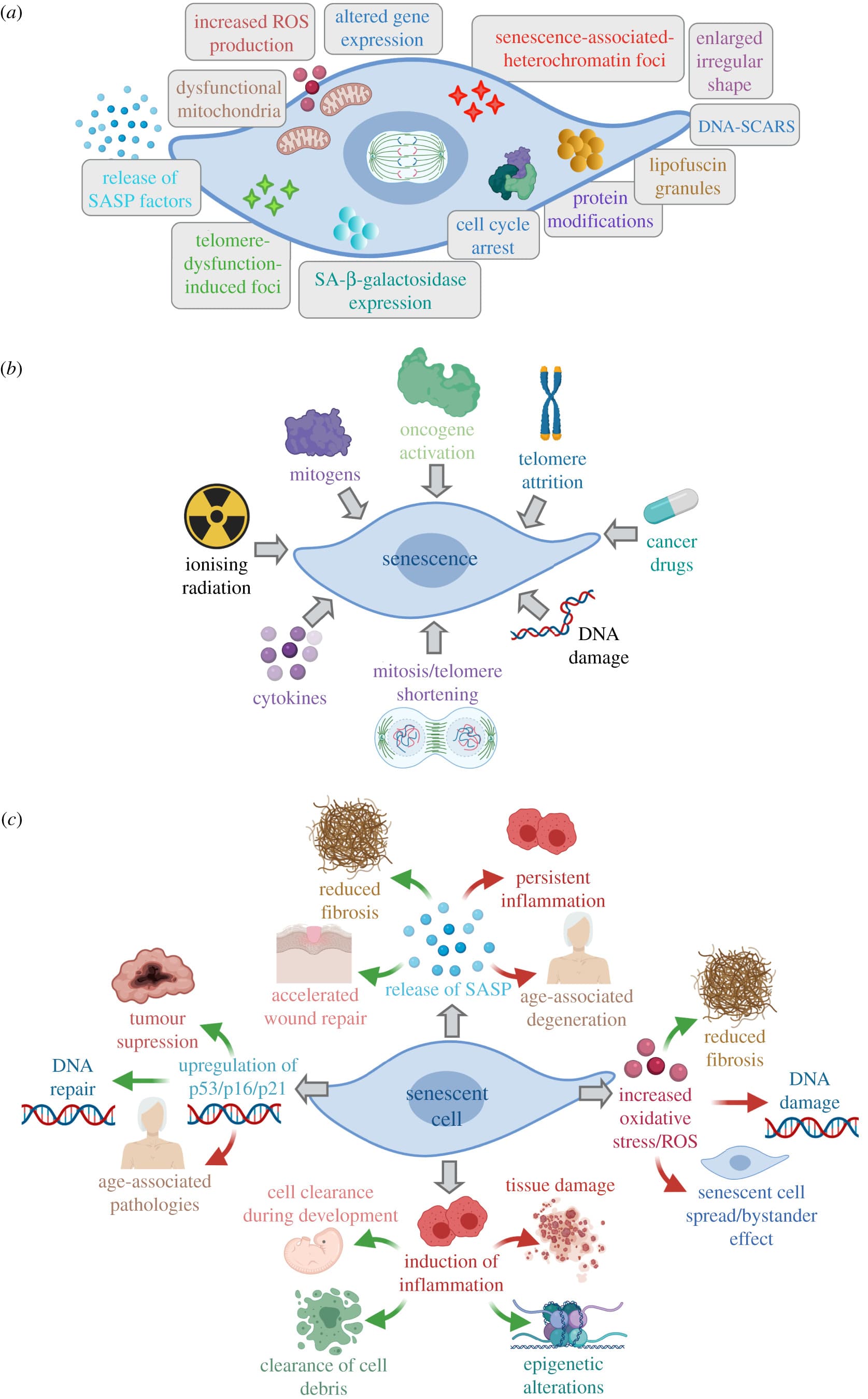
What the review does well is trace the machinery. Several biological drivers appear to feed inflammaging. One is cellular senescence, a state in which cells stop dividing but refuse to die, instead lingering and leaking a cocktail of inflammatory molecules into the surrounding tissue. That leakage has a name, the senescence-associated secretory phenotype, and the review casts it as a central culprit: senescent cells act like smouldering embers, keeping nearby tissue in a state of low alarm. A second driver is a gradually dysregulated immune system, less precise with age. A third is mitochondrial dysfunction, meaning the tiny power plants inside cells begin to falter and produce more of the damaging by-products that stoke inflammation.
These processes are coordinated through molecular signalling pathways, the chains of chemical messengers that tell cells what to do. The review names several that recur across inflammatory aging, including NF-kB, mTOR, JAK/STAT, MAPK and the NLRP3 inflammasome. The names matter less to a general reader than the shape of the story: these pathways together switch on and sustain the inflammatory secretions that damage tissue, which in turn triggers more of the same signalling. It is a loop that reinforces itself, which helps explain why the inflammation of aging is so stubborn.
Where the authors see practical promise is in catching trouble early. They suggest that biomarkers, measurable signals in the blood, combined with functional tests such as how fast someone walks or how strong their grip is, could flag people at risk of mobility decline before it becomes obvious. The logic is that timely, targeted action might preserve movement for longer. It is worth being clear that the review is proposing this as a direction, not reporting a validated screening tool that clinics can use today.
On what might actually help, the authors keep the foundations first. Lifestyle measures, the familiar territory of physical activity and diet, remain the core strategies for dampening inflammaging in their account. Beyond that, they point to emerging options that are still being worked out: nutraceuticals, meaning food-derived compounds studied for health effects, and pharmacological agents aimed at the underlying biology. These are described as promising avenues rather than proven therapies, and the review does not report the kind of large clinical trials that would establish whether any specific drug or supplement reliably protects mobility in people.
The broader significance lies in reframing how we think about losing mobility. Rather than treating a stiff joint or a weak muscle as isolated problems of wear and tear, the review presents them as connected outputs of a shared inflammatory process. If that framing holds, it suggests that addressing the common biological root could do more than treating each symptom in turn. That is an appealing idea, and also one that remains largely at the level of mechanism and hypothesis.
Several limits deserve to sit alongside the optimism. Because this is a synthesis of prior work, its conclusions inherit the uncertainties of the studies it draws on, including the difficulty of separating cause from consequence in aging bodies. Much of the mechanistic detail comes from laboratory and animal research, and what is true in a mouse or a dish does not always translate to a person. The review itself frames extending health span and mobility span as goals to pursue, not as results already achieved.
What this line of research offers is less a prescription than a lens. It invites patients and clinicians to think of movement in later life as something shaped by biology that can, in principle, be measured and perhaps nudged, and it marks out where the next round of careful human studies needs to go.
Sources
- Exploring the nexus between inflammation and mobility through the lens of healthy aging: current scenario and future perspectives.Patusco R, Gyasi K, Kaufmann A · 2026 · Aging clinical and experimental researchDOI 10.1007/s40520-025-03278-zPMID 41609972